

Behind the Scenes of My Developmental Edit
In the fall of 2025, I had reached an impasse with my manuscript. I knew there were problems, but I couldn't name them. So, I did what I usually do when I run out of ideas: I put the story aside and waited, hoping time would bring clarity and inspiration.
This time, it didn't. I realized I needed professional help.
The timing was good. Having just joined CANSCAIP, I suddenly had access to a network of editing professionals who work or have worked in children’s publishing. I contacted a few editors I felt might be a good fit for my story. I sent them an email akin to a query letter, summarizing my story and asking for a quote for SUBSTANTIVE EDITING.
Wrong.
That’s not what I needed.
I'd spent years working as a professional writer and editor, so I was familiar with substantive editing, copy editing and proofreading. What I hadn't really appreciated was how different editing a novel is from editing communications.
The amazing editor who accepted my request for help kindly explained that what I needed at this stage was not substantive editing, but developmental editing. (Read more about the different types of editing used in book publishing, as I understand them.)
Developmental editing is the "forest, not the trees" edit; the first step that EVERY writer who has just finished the perfect, “not-much-to change” manuscript needs. A developmental editor looks at the overall story and asks questions like Does the plot work? Are the characters believable and well developed? Is the pacing too slow or too rushed? Is the point of view consistent? Is the story appropriate for the intended age group?
After reading my manuscript, the editor gave me feedback and suggestions in the form of a detailed editorial letter. It was excellent advice and money well spent.
I want to share some of her notes with you, but before I get to the hard core feedback, I want to share some comments that really boosted my confidence.
“I was immediately transported back to the many wonderful stories I read as a child, and found the tone reminiscent of The Secret Garden or the Narnia series.”
”The themes of grief and loneliness, friendship, and the importance of trusting your instincts are very appropriate for a middle-grade novel and young readers will enjoy exploring the world beyond the Broken Tree right along with Sophie.”
“I wanted to mention how much I loved all the sensory details.”
“This is an excellent story…”
(Get this: Before reading her comments, I had NEVER read The Secret Garden! I promptly got my hands on a copy and read it.)
As you can imagine, sharing a piece of creative writing—or any creative work, for that matter—with a professional who has seen it all when it comes to children’s literature can leave you feeling a bit vulnerable. I believed in my story, but her kind words were extremely welcome at this stage in my writing journey.
Now for the meat. Let’s take a deep dive behind the scenes.
The editor identified several general areas that needed work: point of view, voice, tone and pacing. She helped me see when my voice became too authorial and noticed that the first two chapters sounded different from the rest of the manuscript (by which time I had found my groove and sounded more natural). As soon as I read her feedback, I knew these were the issues I was having trouble articulating. I was so excited to dig in!
She spotted slips in point of view. I've learned some editors refer to this as "head hopping." My editor explained that it’s okay for me to change POV, as long as I map it out more obviously.
Once a skilled editor identifies when you have hopped heads, it’s easier to see. Here’s a small example from Chapter 1, “A Lost Balloon,” when the main character, Sophie, greets her papa as he pulls into the driveway with the balloons he bought for the party:
“Papa!” she cried, leaping off the porch as he pulled into the driveway.
He smiled, taking in the wreath of flowers in her long blond hair and delicate wings that completed her costume. Then he reached into the car and pulled out a shimmering bouquet of floating balloons, handing her a silver one.
The italicized portion shows where I accidentally shift from Sophie’s POV to her papa’s.
To keep my scenes firmly anchored in a specific character’s POV, I found it helpful to ask myself specific questions throughout: What would this character see or feel or know at this moment? What would this character NOT see or feel or know at this moment?
The newer version reads like this:
“Papa!” she cried, leaping off the porch as the car pulled into the driveway.
“Wow, you really do look like a fairy princess,” he said, stepping out and delicately touching the crown of flowers in her hair.
“Thank you, Papa,” Sophie said. “Mumfred and I finished everything while you were out,” she added, turning to reveal the delicate wings that completed her costume.
Her father reached into the car, pulled out a shimmering bouquet of floating balloons and handed Sophie a silver one.
Here’s another minor example from Chapter 4, “Invitation to a Feast.”
Crouching nearby, Wimple looked fretfully at Sophie.
“Will you not go to the feast?” he said sadly, inching closer.
In this exchange, Sophie can only guess at Wimple’s feelings by what she observes.
Here is the rewrite:
Crouching nearby, Wimple looked at Sophie. He seemed nervous.
“Will you not go to the feast?” he asked, inching closer.
I am still spotting moments when I accidentally slip out of a character’s POV, but they are easier for me to see now, and were part and parcel of much larger feedback that changed everything for me: deconstruct each scene.
My editor explained that once a writer has a workable draft, it’s a good idea to do a forensic analysis of every scene to ensure it’s actually carrying its weight.
She suggested I reread each scene individually as if I were reading them for the first time and ask myself these questions: Whose POV is it? What happens? How does it drive the story forward? What do you learn? Is there anything there that doesn’t serve a purpose? She laughingly suggested I compile my notes in a chart and I laughingly thought, You had me at chart.
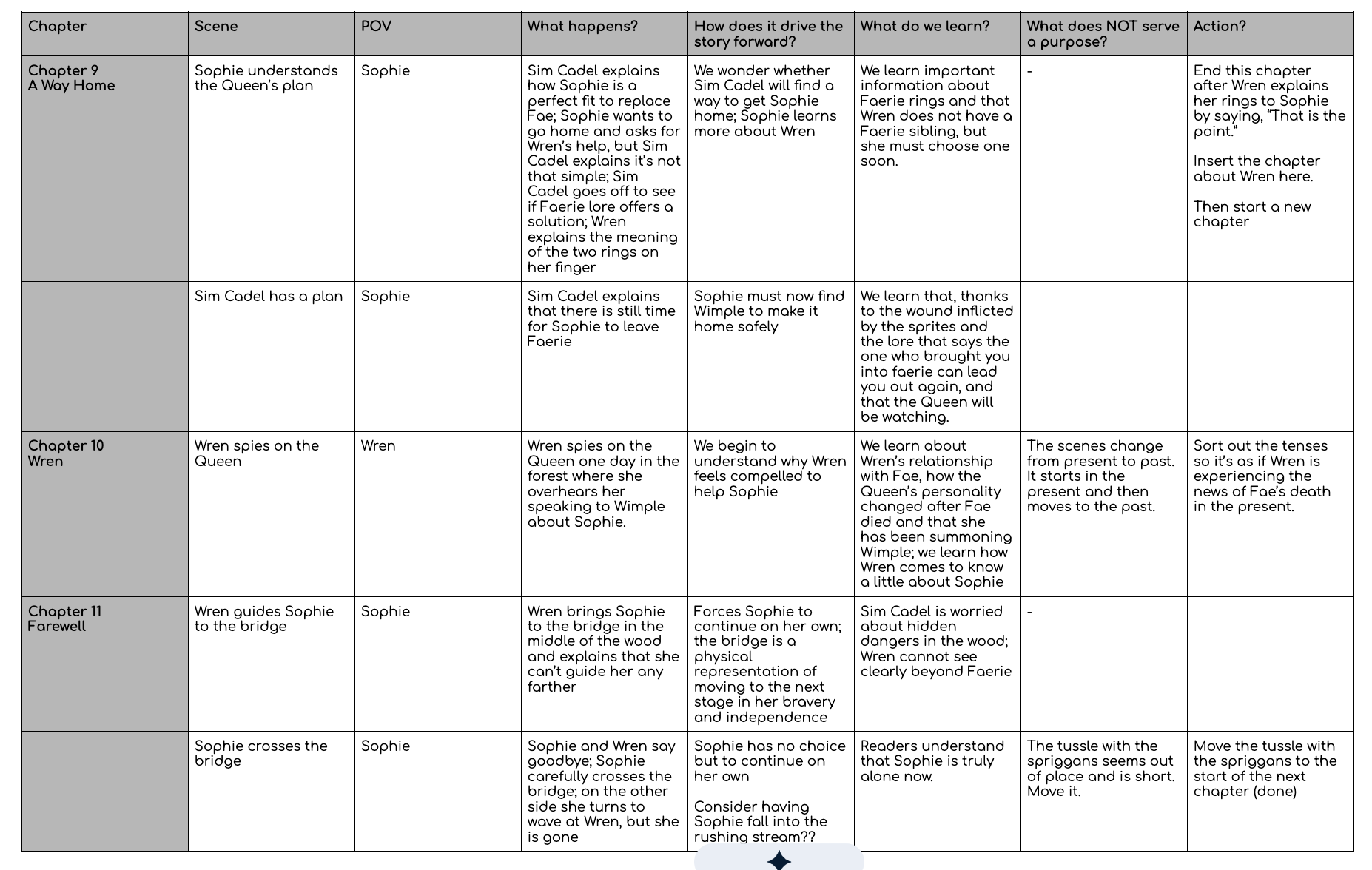
Here’s a portion of my glorious chart, but know that the storyline has already changed and that each chapter may comprise more than one scene.
The scene deconstruction exercise took a lot of hours, but was exactly what I needed. The former editor that I was, I was kicking myself for not having thought to do this myself. (I recently went back through all the notes I took at the Surrey Writers’ Conference and discovered scene deconstruction was one of them. Ugh. Embarrassing.)
Once I had finished my analysis, I scrolled to the top of the chart and used my notes to guide my revisions. I further defined the various character voices with respect to POV and tightened up chapters by either combining them or breaking a few longer ones into shorter ones. At the editor’s suggestion, I moved back-story details out of a middle chapter and into the prologue where it sets up the storyteller nicely, and added new details and scenes that had come to me in the downtime I allowed myself while the editor was reviewing my work. Even now, I am adding layers and changing things around. What was once a final chapter is now the epilogue.
Before working with a developmental editor, I felt stuck because I couldn't see my own manuscript objectively. Examining my story scene by scene transformed the revision process. The ultimate result was a more polished, professional and cohesive manuscript. Making the chart was an amazing starting point and since creating it, I have made numerous improvements. I feel confident that everything that remains moves the story forward and serves a purpose. That's what this great editor gave me—not better ideas, but a clearer way to see the ones I already had.
My manuscript is complete, but still evolving. Now my goal is to prepare it for agents and publishers, and for the first time, I feel like it's ready.